
What is happening about halal student loans?

WHAT IS STUDENT FINANCE?
Student finance in the United Kingdom is funding that is available for students to access to help cover the cost of their further education. The organisation that is responsible for administering and calculating the extent of the student loan payment is the Student Loans Company.
The Student Loan Company was founded in 1990 and was created to provide students with financial support towards their further education. Currently, student finance can be applied for by students to pay for their university tuition fees and living costs while they are studying.
Every student in the UK is entitled to a loan to cover tuition fees. Tuition fees tend to be decided by the universities and the Student Loan Company will make the payment direct to the educational establishment. Currently, in the UK those studying full time can receive up to £9250 per annum towards tuition fees, and additional funds for living costs known as the maintenance grant.
Repayment Of Student Loans
Student loans need to be repaid in full whether or not the student completes the university course or not. The amount you repay depends on your income and is deducted from your salary in the same way National Insurance and tax are deducted.
You become eligible to repay your student loan (with interest) once your income exceeds a certain threshold. In the UK this threshold is currently around £25,000 per year. Repayments are calculated at 9% on sums over the threshold, and the repayment is subject to interest charges.
WHAT IS MEANT BY HALAL STUDENT FINANCE?
Halal student finance in the UK refers to those financial arrangements that students can access to advance and fund their further education. Any halal student finance or loan needs to be compliant with Islamic finance and Sharia principles relating to money.
Specifically, Islamic student finance means that there should be no interest payable or charged on the loan or fees associated with education. Islamically, interest is considered to be haram and should be avoided at all costs.
The concept of halal student finance is structured to ensure that is adheres to Sharia rules and that the financing of education is compliant with ethical and religious rules. The main principle to be aware of is that the arrangement must not involve any form of interest and the transaction should be non-exploitative and transparent.
For many Muslim students, not having access to halal student finance via the Student Loans Company means they do not pursue their further education goals. The main reason for this is that the current student loan system is based on interest repayments.
Student Loans And Interest
Interest on student loans is an integral part of the system that funds further education. This is generally how student loans operate:
- Student applies for university, is accepted on to the course, and then makes a student loan application.
- There are two main elements to the student loan:
- Tuition fees that cover the cost of the course tuition
- Maintenance loan that is aimed to help with the living costs including rent, and books.
- To be eligible for a student loan you need to be resident in the UK and have been accepted on to a course.
- Repayment of the student loan includes interest and the rate of interest depends on factors such as when you took out the student loan. Repayment only begins post graduation and once you earn over a certain threshold.
- Interest on the loan accrues from when you receive the funds until the full loan is repaid.
In addition to student loans, there are also scholarships and bursaries available for some students. Postgraduates can also apply for student finance but whether they receive it or not depends on their circumstances.
Before considering any form of loan it is important for you to gather all the information relating to the loan and how it impacts you now and in the future. Whilst many see student loans as an investment in the future, there have been concerns raised about the inability of Muslim students to access student finance.
WHY IS IT IMPORTANT FOR MUSLIM STUDENTS TO ACCESS HALAL STUDENT FINANCE?
Muslims want to be able enter and partake in higher education without breaching Sharia rules. Currently, as the UK student loan system is interest-based, this precludes many Muslims from being able to access the funding they need to study further.
Islam prohibits interest and at the moment there is no interest-free funding option for students. There is a need for student finance based on Islamic finance principles that form part of the student loan scheme in the UK.
It's not only the interest element that is a problem for Muslim students. The existing student loan system is subject to change and this could fall into the remit of gharar (uncertainty) in Islam which is discouraged.
Without doubt, a halal payment system for Muslim students will facilitate greater inclusion in the education system.
Islamic Finance And Student Loans
Some key features of a halal student loan include the following:
- interest free loans: it goes without saying that any form of student finance must ensure there is no interest being charged or paid in order for the loan to be deemed halal. Instead, what is expected to happen is that the lending institution or bank charges fees or alternative structures to fund the transaction.
- Ethical: halal student finance cannot be unethical. This goes against the basic Islamic finance principles. Any halal form of finance or funding needs to steer clear of haram industries such as gambling, porn, and alcohol.
- Transparent: for a student loan arrangement to be compliant with Sharia rules, it must be transparent and clear. Both parties in the transaction should fully understand the terms which themselves should be clear and non-ambiguous.
- Risk and profit sharing: a key component of Islamic finance is that there is adequate profit and risk sharing between the parties. The student should not bare all the responsibility and risk in this kind of arrangement.
Consultation On Halal Student Finance
In 2014 the government launched a consultation relating to Islamic finance based student loans. What they found was that of the 20,000 respondents, over 90% stated that there was a demand for Sharia compliant student finance.
In March 2023 the government in the UK (having consulted on lifelong loan entitlement) confirmed that although a Sharia compliant student finance product was not available, it was committed to funding an alternative form of finance for students.
The government discussed several criteria that should be applied in a halal student finance system including:
- repayments should be easy to make
- any alternative system should be operated through the student loans company
- debt and repayment levels should be the same as they are for other students
- the service should be easy to use and transparent
Halal Student Finance And The Takaful System
At the time they were considering halal student finance options, the government concluded that a takaful system would be most appropriate. In Islam takaful refers to Islamic insurance and is based on cooperation and mutuality.
Takaful systems operate without insurance or gharar.
Unfortunately, no halal student finance option ever really emerged. Instead the government focused on other areas of student finance and simply concluded that they would continue to consider halal student loans.
Whilst government controlled and regulated student loans may not be available as yet, there are still halal finance options available. Some financial institutions are offering Sharia compliant loans that could be used for education.
Tips For Students Who Want Halal Student Finance
For students who are looking for halal student finance alternatives, here are some options you can consider:
- Research Islamic finance products and services
- Look into Islamic scholarships
- Speak with Islamic finance advisors
- Speak to your university finance team and ask them for details of hardship funds or grants
- Consider interest-free loans from family
None of the above are ideal for Muslim students but could provide alternative halal funding for further study.
The future of halal student finance is dependent on many factors including the demand, the economic landscape, and the continued growth of Islamic finance. The Islamic finance industry is innovative and dynamic and could partner up with educational establishments in the future.
Increased awareness and education about the need for halal student loans is also something that could potentially speed up the availability of halal loans. Muslim students need to stay informed and alert and always explore all the options available to them before deciding against pursuing further education.
Explore more news
The current cost of living crisis in the United Kingdom is affecting everyone. For many households, this is the highest squeeze on their finances that they have experienced. Many people are being forced to take measures in order to stay afloat. The cost of food, goods, and utilities are continuing to rise at an alarming rate, and people are having to make smart financial decisions.
According to recent statistics, up to 18 million households could face fuel poverty by January 2023 due to the ongoing energy crisis. Many of these families will have to decide between heating and eating. Investment bank Citi estimates that the UK consumer price inflation could reach 18% by early 2023. This will not only affect the finances of couples, and families with children, but almost everyone in the country.
This is why it is vital that you make smart financial decisions that could help you ride out this current cost of living crisis.
Let's have a look at some of the ways in which you can make your money go further.
Plan And Budget
One of the best things you can do is prepare a spending and budgeting plan. This will help you identify if you are overspending and examine those areas where you can cut back and save costs.
For example, do you still need to have a full Sky TV package? Can you get a cheaper broadband deal? Do you have any subscriptions that you no longer need or use?
Go through each direct debit and see if you can reduce or remove it. Check what you are paying for your smartphone packages and see if these can be reduced in any way. Ring your providers and ask them if they have any better deals on offer that could lower your costs.
Track all of your expenses and payments. This is the only way that you can successfully budget. Information and knowledge are power so use them to your advantage. Create a spreadsheet or table that lists all your incomings and outgoings, and then have a close look at where your money is going.
Muslims will already be used to the concept of planning and budgeting as they have to reconcile their finances and accounts every year in order to calculate their zakat calculations.
However, it is a good idea to keep a more regular eye on your finances, and remember that any drop in your income and savings may also affect your zakat and sadaqa payments.
Live Within Your Means
This is really important. It sounds so simple, but many people in the UK live beyond their means and this means they will struggle during the recession.
Having debt is not so much of a problem when times are going well. However, if you fail to make your repayments things could go wrong very quickly.
There is a famous Arabic proverb that states 'cut your coat according to your cloth'. Essentially, this encourages us to live within our means and not overstretch ourselves financially.
Islam does not look favorably on those who spend excessively and keep increasing their debt. We should all be looking at how we make use of our resources and expressing empathy for those less fortunate. Managing our finances well is something everyone needs to do, and needs to learn to do better.
Pay Off Debts
It might sound obvious but it is vital that you pay off any debts that you are able to. There are many online debt advice helplines that offer you recommendations and a guideline to help you reduce your debts.
You should prioritize paying off any debt, especially if it is a debt that accrues interest. Interest is not only strictly prohibited in Islam, but is also detrimental on your finances as the interest rates are likely to continue to increase.
If you can, pay off your debts.
Do Not Accrue New Debt
If you are thinking of taking on a new loan or new debt then think twice. Especially if the debt will be accrued due to a purchase that you do not necessarily need.
The same applies to buying things using your credit card. Now is not the time to be accruing more debt that incurs interest.
Start Saving Now
If you can, start saving now. It is never too late to start saving. Good financial management not only means monitoring your spending habits, it also means looking at your savings strategies.
You may need to undertake an evaluation of all your incomings and outgoings to see if there is anything you have left to save. If you do, even if it is a small amount, it is never too late to start saving.
If you do not have an ISA now is a good time to find information about what savings products are out there. For Muslims, there are some halal savings accounts that do not pay interest.
These halal savings accounts offer the same banking services as conventional savings accounts without interest.
Set Savings Goals
Set savings goals for yourself. This could be as little as saving £10 a month, to saving much more.
If you are saving to buy your first home, then you will likely be impacted by the increase in interest rates.
Look for banks and lenders that offer halal mortgages based on Islamic finance principles. Halal mortgages tend not to be as dependent on standard interest rate fluctuations and offer more stable repayment options.
Invest
Many people are scared of investing during a recession or economic crisis, but there are some good investments out there that can generate revenue and income.
Do your research and have a look at what investment opportunities are out there for you.
Investing in the right funds, stocks and bonds can be inflation busting. If you do your research you could find investments that offer a good rate of return. For Muslim investors, there is a range of halal investment options on the market which tend to be more stable than the conventional stocks and shares.
If you want to minimise the risk when it comes to investing, then try not to be too exposed to a limited number of sectors or assets. Diversifying your portfolio via investment is a good way to spread your money with less risk.
Think About Side Hustles
Side hustles have become popular in recent years when it comes to generating additional monthly income. Some low cost side hustles that have been successful in recent years include the following:
- Amazon selling
- Etsy selling
- Selling digital art and services
- Creating a website
- Freelance graphic designing
- Freelance writing
- Blogging and vlogging
- Social media influencing
- Shopify
- Dropshipping
- Creating online courses and offering advice
- Affiliate marketing and advertising services
- Starting a podcast
- Using comparison and cash back websites
These are just some side hustles that require very little financial outlay at the start.
Undertake Due Diligence Before Making Big Financial Purchases And Decisions
If you are thinking of making a big purchase such as a home or a car then make sure you do all the necessary research. Use comparison websites to find the best prices for things like electrical goods and holidays.
When it comes to home purchases, remember the housing market is likely to undergo some change in the coming months.
It might be better to sit tight to see if there is a fall in house prices. You should also look at different funding options such as halal mortgages. These types of mortgages tend not to have fluctuating rates as they are not interest based loans.
Take Your Time - Don'T Be Hasty
This is important. Now is not the time to make rash decisions or rush into big purchases or commit to long-standing and expensive monthly subscriptions.
Whether it is a smartphone or a new streaming service, take your time in deciding whether you definitely want to commit some of your monthly income to it.
WHAT IF YOU ARE SELF-EMPLOYED?
For the self-employed there are some additional concerns during a recession. For a start, whilst you may already be accustomed to fluctuating monthly income, you may see a drop in overall income as your customers feel the pinch and cut back on their spending.
Rising inflation is likely to affect all businesses, irrespective of size and industry.
Now is a good time to look at your personal finances, and check to see that you can:
- meet your mortgage repayments or rental payments
- meet all your essential direct debit payments for things like utilities
- have enough money to cover food and groceries for at least 3 months
- have some savings to fall back on in case your monthly income drops
- cut back on any non-essential items of expenditure
Some Ways You Can Protect Your Money
The Bank of England recently raised the interest rates. When this happens, it is usually an indication that the Bank of England wants people to start saving more and spending less.
Some ways to future-proof your money and savings include the following:
- Pay off as much of your existing debt as you can
- Make changes to your living standards that would bring your costs down
- Check to see if you can consolidate any of your debts
- If you have investments, check up on them and see how they are performing
- Save for a rainy day - even a few pounds a month will soon add up
- Track your spending by separating your wants from your needs
- Limit spending on gifts
- See if you can fix your mortgage if you are currently on a variable rate, there are some deals to be had out there

Since student loans were first introduced in the United Kingdom in the 1990s they have proven to be problematic for Muslim students. The primary reason for this is that student loans incur interest - something that is prohibited in Islam under Sharia rules.
For many Muslim students who want to be compliant with Sharia laws relating to financial transactions, taking out a student loan is not seen as a viable option.
Riba In Islam
The literal Arabic meaning of the word riba is 'increase', 'growth', 'excess', or 'addition'.
According to Sharia laws, an increase of a debt owed or repayment of a loan is considered to be riba, or interest. This is strictly forbidden in Islam. Both the payment of interest and the receipt of interest payments are considered to be contrary to Islamic Sharia rules.
The reason Islam does not permit interest is that it is considered to be a means through which the poor remain poor, and the rich get richer. There is considered to be an inequality between the parties and within the transaction.
Riba is generally deemed to increase the gap between the poor and the rich in society and this goes against Islam and the social responsibility message that permeates Islam.
Student loans within the UK are currently repayable with interest, so this creates a dilemma for Muslim students.
Interest And Student Loans
As student loans require repayments that incur interest, many Muslims deem them to be an unacceptable way of funding their higher education goals.
There has been a great deal of debate within the Muslim community about student loans and the issue of riba.
Islamic Concept Of Finance
One important thing to note for anyone considering taking out a student loan is that traditional western banks and lending organisations treat money solely as a commodity in business.
By contrast, in Islam, money is considered to be a medium of exchange with a measure of value only.In Islam, money performs a social role.
The value of the money is stored within it, not outside it. This is one of the primary reasons riba / interest is not permitted.
Student Loans - History
Student loans have had a variable history. In the 1960s, 12% of school leavers went on to university. This represented 1 in 10 students. There was no such thing as student loans in the 1960s. University fees were actually paid fully by local education authorities. Students left university with little to no debt.
In addition to having fees paid, university students could also apply for a means tested annual grant to cover their living costs.
In the 1970s the number of school leavers attending university increased slightly to one in seven. By the end of the decade, this figure had dropped again as there was a squeeze on university funding.
The 1980s saw a huge increase in the numbers of students wanting to go on to higher education. The then education secretary, Kenneth Barker, pushed for higher numbers of young people to attend university and increase their skill sets.
By 1990, one in five school leavers was attending university. However, the maintenance grants had not increased by much, so in 1989 the Tory government introduced student loans akin to mortgages. These loans were to account for having no increase in the annual student grants and were intended to bridge the gap between the funds available and the increased cost of living. Grants of up to £2265 were available on a means tested basis.
Higher education and university entry really saw a boom period in the 1990s onwards. More and more young people were going to university and the number of courses available increased.
The Labour government got rid of the grant in 1997 and replaced it with a new policy and system whereby a £1,000 means tested tuition fees was available, alongside low cost loans.
By the early 2000s, many more young people were attending university. The Labour government pledged to raise the percentage of young people going to university to 50% and they wanted to make sure students had an incentive to study further. Tuition fees amounted to £1,100 per year, and this was offset by loans of up to £3,950.
In 2006, tuition fees were raised to £3,000 per year which become payable once students graduated and were earning above £15,000 per annum. Students were informed that the repayments were to be made on the 9% of income over the relevant threshold, with inflation-only interest rates.
Coming to modern day student loans, tuition fees are currently £9,000 per year and additional loans are available that could amount to over £12,000. This means that an average university student who undertakes a 3 year degree will come out of it owing a considerable debt. This debt accrues interest.
In the United Kingdom, it is the Student Loans Company that administers and monitors student loans. The Student Loans Company is the organisation that calculates the amount payable to individuals and ensures the payment reaches the right bank account.
INTEREST ON STUDENT LOANS - IS THIS RIBA?
Opinion is divided about whether student loans are considered to be halal or haram.
There are some Islamic scholars who believe that student loans are inherently haram and non Sharia compliant as they incur interest. However, there are also scholars who have the opinion that student loans are halal.
Let's have a look at the arguments for and against student loans.
Fatwas That Deem Student Loans To Be Haram
The Al Qalam Institute did its own research and issued a fatwa relating to student loans and their permissibility for Muslim students. The issue they looked at in detail was whether the repayment of the student loans was commensurate with inflation rates, or whether the repayments incurred 'bolt on' interest payments.
The research the Al Qalam institute undertook concluded that the student loans at the time of the fatwa (2013) were deemed to incur riba. This meant that student loans were contrary to Islamic laws relating to finance and loans.
The reasoning behind the judgement was that student loans DID attract riba and were not simply attracting inflation based increases in repayments.
According to the Institute, irrespective of the need for the loan (ie to further a person's education, knowledge, and prospects), if a loan incurs interest then it is prohibited.
There is still a great deal of ongoing debate amongst scholars about whether the loans are strictly linked to index price/inflation raises or whether they do actually incur interest outright.
It is likely the debates will continue for some time until any consensus is reached.
Arguments And Fatwa In Favor Of Permitting Student Loans
There are, however, other schools of thought that have the opinion that by their very nature, student loans do not fit the traditional definition of a loan.
Some Islamic scholars have raised the question of whether student loans do in fact incur riba and whether they should fall under the definition of what a de-facto loan is.
The reasoning behind this argument is that any student who obtains a student loan will never fully take ownership of the loan amount.
The student loan itself is seen as an investment towards a future of learning.
As the bulk of the student loan is given straight to the university or institute of higher education, the student never actually receives full ownership of the money. Without ownership it is questionable as to whether student loans are actual loans under Islamic finance principles.
In addition to the above, it can be argued that as the loan only becomes repayable once a student earns over a certain threshold, there is no automatic interest based repayment.
Shaykh Dr. Haitham al-Haddad has issued his own fatwa relating to student loans. It is his opinion that taking out a student loan is permissible. He maintains that no riba is involved in the student loan transaction.
Shaykh Dr Haitham al-Haddad has researched this issue at length and concluded that student loans within the UK are permissible under the rules of Islam.
The Shaykh raises the following points to note when arguing that student loans are halal:
- the student never receives the full loan amount
- the student does not have full control of where the money is spent nor is there any element of profit
- the loan is eventually written off (cancelled if you die)
- the minimum earning threshold applies before any repayment is due
According to the Shaykh, the points mentioned above render the student loan as an entity that is different from the traditional loan, or qard.
The element of human ownership is not fulfilled as the monies are paid (mostly) directly to the university in lieu of tuition costs.
Of course, opinions on this issue continue to remain divided.
Students are encouraged to undertake their own research and due diligence.
Want Versus Need
Some scholars are of the opinion that there will never be a clear cut answer on whether student loans are considered to be halal or haram.
However, students should always consider whether their desire to pursue further education is a want or a need. If university is seen as a want - that is, it is not essential - then taking out extensive student loans might not be a good idea.
However, for those people who have no choice but to go to university such as doctors, lawyers, and dentists, perhaps there is an argument to say that there is a real need.
Not everyone who attends university is entitled to a bursary or scholarship and it would be a shame for these students to miss out on learning or advancement.
What is clear is that many Muslim students (and parents of students) have felt unable to access Sharia compliant and appropriate student finance. This has affected their employment prospects and their career progression.
Whatever your view of student loans, the UK does need to identify and create solutions that are accessible for Muslim students.
Conclusion
Ultimately, when deciding if student loans are halal or haram. students should be doing their own research on whether they feel comfortable taking out student loans.
Always seek out the knowledge of experienced and knowledgeable scholars. Use a website that you trust to find out more information, and read the opinions and advice of scholars who have researched the topic extensively.
Whilst not all Islamic scholars agree on whether student loans are halal or haram, what is clear is that the subject is still open to debate. Perhaps this is the reason that more and more universities are directing their Muslim students towards Sharia compliant loans and finance options.
In addition, the Federation of Student Islamic Societies, and the National Union of Students have been working collaboratively with the government to find alternative finance solutions for Muslim students who do not want to go down the traditional student loans route.
In the meantime, it is worth having a look at the various scholarships and bursaries available. These could be an alternative form if financing but it is rare to find one that will cover a full university course plus living costs.
In addition to this, many UK banks offer interest free current accounts up to a certain limit so it is also worth checking these out.
The UK government has been looking into having an alternative financing option for Muslim students to ensure that they have access to higher education.
In 2014, the government approved a non-interest based student loan model, and this is still under review.
However, in June 2022, the Federation of Student Islamic Societies reported that a date has been finalised for the non-interest based student loan and it would be available in 2025.
Until then, of course, the most beneficial course of action would be to seek out halal funding options. There are service providers available who provide Sharia compliant loans and products. In addition, there are some Muslim charities who will fund higher education.

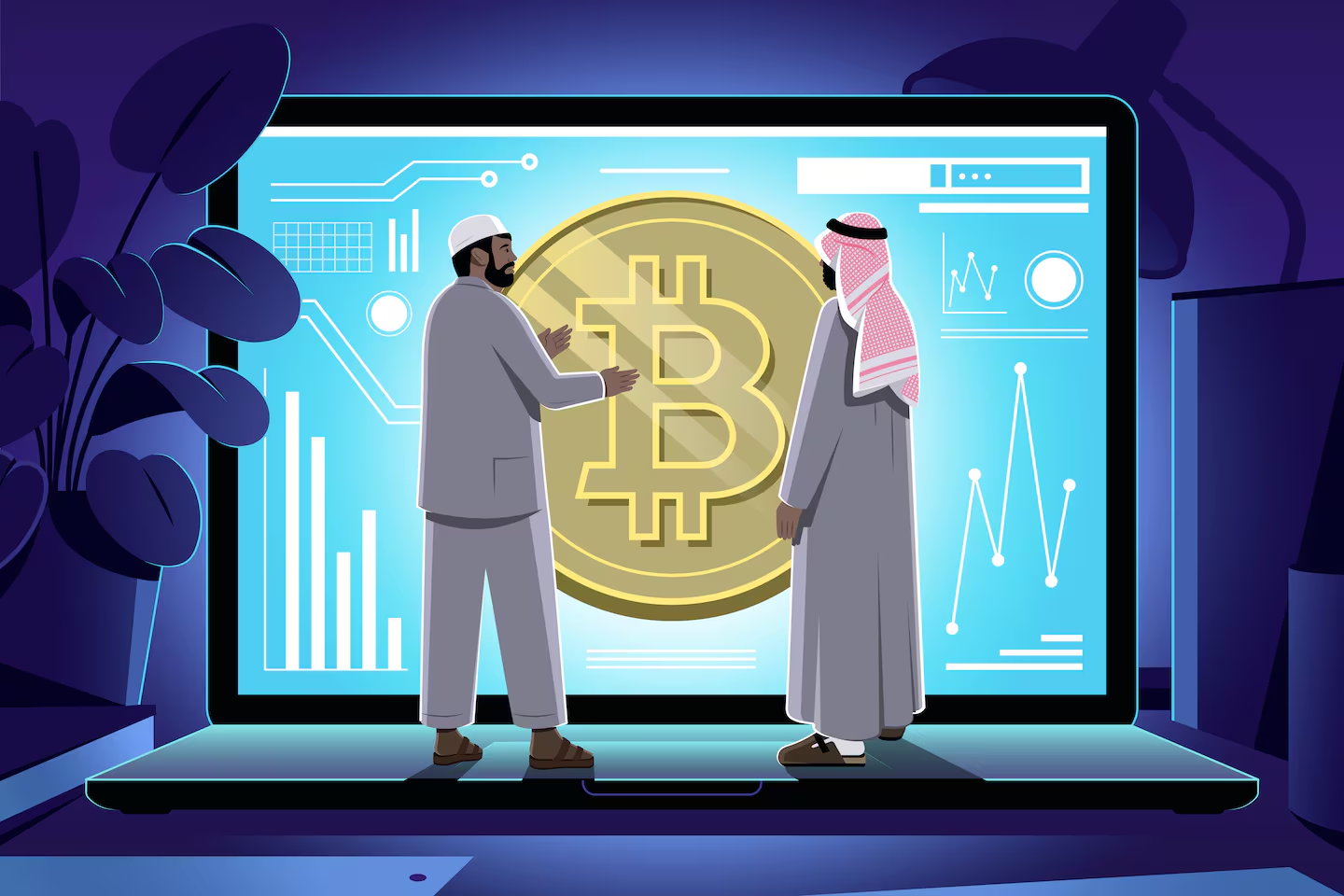
Cryptocurrency, as it is known today, started with Bitcoin as the first decentralised cryptocurrency in the modern world. The first Bitcoin transaction took place as far back as 2009 and ever since Bitcoin has grown into a global phenomenon bypassing traditional finance systems and banks. Islamic cryptocurrency, also known widely as Islamic coin, began to emerge in the late 2010s as the demand for Sharia-compliant digital assets grew.
Islamic coin is Sharia-compliant cryptocurrency that adheres to Islamic finance rules relating to financial transactions and exchange. This article will examine the benefits of Islamic coins and their relevance in the modern world of finance.
Cryptocurrency And Islamic Finance
Over the years Islamic finance and the world of cryptocurrency exchange and platforms have become increasingly interconnected. Islamic coin merges the traditional with the modern, uniting decentralised currencies with Sharia principles.
Not only does the Islamic coin stand as a testament to the thriving impact of Islamic finance on the modern world, but it also offers Muslims an alternative and innovative way of managing their money.
Two notable initiatives relating to Islamic coin are the First Islamic Crypto Exchange (FICE) and project Onegram. Project Onegram is a project that aims to create an Islamic cryptocurrency coin that is backed by gold reserves. Users of the coin are able to store their coins in a digital wallet and transact securely.
FICE is an Islamic initiative aiming to provide an Islamic digital platform for cryptocurrency transactions that are fully compliant with Islamic finance rules.
The main features of FICE are:
- it employs ethical screening
- it incorporates community governance within its structure and operations
- it offers Sharia-compliant trading
FICE and Onegram are both efforts to bridge the gap between Islamic finance and blockchain technology. The aim is to offer Sharia compliant solutions to Muslim investors in the realm of digital and decentralised finance.
Main Features Of Islamic Cryptocurrency
There are some key features that differentiate Islamic coin from other cryptocurrencies:
- Asset backing - Islamic coin is based on a system of asset backing. This not only provides intrinsic value but also stability in line with Sharia rules. Often the digital coin is pegged to assets that are tangible such as gold, real estate, silver, and commodities.
- Transparency: Islamic coin transactions must be transparent if they are to comply with Islamic finance rules. This means any trade, investment, platform being used, sales, prices, return, market, service, and exchange involved must be halal and transparent.
- Sharia law: Islamic coin must be Sharia compliant. This means the coin itself cannot be involved in any form of interest, uncertainty, or speculation.
- Governance: the governance relating to Islamic coins is usually decentralised. This is looked upon favourably by Islamic finance as it means there is more scope for the community to be actively engaged in the governance structures and processes.
- Regulation: Islamic coins, whether in the UK or abroad, must comply with regulatory frameworks that govern digital assets and finance. Digital assets are seen as a valuable commodity and many countries already have robust regulatory frameworks in place.
WHAT IS AN ISLAMIC COIN?
Islamic coins are essentially a form of cryptocurrency that is Sharia compliant. Muslims have an incentive to partake in Islamic coin trades and investment as they can be reassured that the coin is fully halal.
Of course, this means the coin must be certified as Sharia-compliant by experts with knowledge of Sharia law and rules.
For example, Islamic coin cannot be aligned or involved with any industry or market that is prohibited in Islam such as the gambling or alcohol industry. There is also a requirement that Islamic coin investment considers social benefit and social purpose as per Islamic finance rules. The ethics of the management and investment of Islamic coin are also important for adherence with Islamic finance.
WHAT ARE THE BENEFITS OF ISLAMIC COIN?
Islamic coin offers many benefits to its users:
- It is Sharia-compliant and aligns with Islamic principles
- It is transparent
- It is stable
- It facilitates the creation of strategic partnerships and ethical investment
- It provides innovative financial solutions
- It supports marginalised communities
- It uses ethical investment criteria
- It facilitates and enables financial inclusion
- It enables cross-border transactions
- It operates on a profit and loss sharing arrangement
- The HAQQ platform screens for Sharia compliancy
Islamic coins offer many benefits to Muslim participants and investors looking for halal ways to invest and trade. As the cryptocurrency financial ecosystem continues to evolve, Islamic coin will play a key role in shaping the future of Islamic cryptocurrency and digital assets.
WHAT IS THE DIFFERENCE BETWEEN ISLAMIC COIN AND BITCOIN?
When considering cryptocurrency, the question always arises about the difference between Bitcoin and Islamic coin. The main difference is that Islamic coin adheres to Islamic finance principles. The very existence of Islamic coin is to ensure that Sharia rules are complied with and there is no such obligation on Bitcoin.
Whilst both coins operate on decentralised platforms, Islamic coin should incorporate more transparent structures of governance leading to greater accountability and proof of adherence.
In addition, another key difference is that Islamic coin needs to follow ethical investment screening and criteria in order to the compliant with Islamic finance. Islamic coins operate on the HAQQ blockchain.
Whilst there are similarities in the nature of both Bitcoin and Islamic coin, the main difference is that Islamic coin adheres to a different set of values and principles. Users of Islamic coin will therefore seek assurance of compliance with Islamic rules relating to finances.
WHAT IS THE FUTURE OF ISLAMIC COIN?
More and more Muslims are looking to invest in and trade in Islamic coin. The Sharia Authority which was formed for the purpose of making decisions on the validity of cryptocurrency has stated that Islamic coin is a financial asset that can be traded whether that is by sale and purchase, or traded for goods and services.
Islamic coin holds great potential in the crypto world. As the crypto ecosystem and infrastructure continue to evolve there are some trends that suggest Islamic coin will see great growth in the coming years:
- Global financial inclusion: Islamic coin is playing a central role in making sure underserved Muslim-majority regions are able to partake in digital currencies. The demand is already there and is growing.
- Islamic finance growth: as the Sharia compliant finance industry grows so too does the demand for the accompanying digital ecosystem.
- Evolving markets: as the dynamics of markets in the world continue to grow and develop, Islamic coin is predicted to grow alongside them. Collaboration and innovations are already being seen across many different regions.
- Adoption: increased adoption of Islamic coins will lead to greater liquidity, market development, and acceptance.
WHAT ARE OTHER HALAL COINS TO INVEST IN?
Whilst the list of halal cryptocurrencies is growing, it is important to note that cryptocurrencies as digital assets are not deemed to be automatically compliant. They need to be screened by experts against Sharia principles. Some coins that have been deemed to be halal include:
- ZRX
- ELF
- Aion
- Alchemy Pay
- ASTA
- BEAM
- Cardano ADA
- Chainlink
There are many other coins that are deemed to be Sharia-compliant, but in each case you must do your own research and satisfy yourself.
Stay informed on finance
Subscribe to our newsletter for the latest insights on ethical financing